What Changes for the Senior Engineer
Part 0 — Foundations
"Late judgment was the compensation that made vague specs work. The compensation does not survive automation. The judgment has to move."
Who this chapter is for
This is the one Foundations chapter with a specific audience rather than a universal one. The book's primary reader is the tech lead, staff engineer, or platform-team member on the hook for an agent system; this chapter speaks to that reader's career question, not their system-design question. The other Foundations chapters (What is AoI, Intent vs. Implementation, the four dimensions, the failure taxonomy, the Intent Design Session) are load-bearing for every reader — without them, the rest of the book does not parse. This chapter is not load-bearing in the same way. A reader who is not personally navigating the transition can skip it on first read; the chapters in Parts 1–5 do not assume it.
It is in Part 0 anyway because the reframe it offers — late judgment moves upstream into the spec — is the personal counterpart of the framework's structural claim, and many senior engineers will not adopt the framework's discipline without working through that reframe first.
Context
The senior engineer reading this book is the person who, until recently, was the framework. They compensated for vague specs by exercising late judgment. They escalated ambiguities rather than executing them. They rewrote tickets into what was clearly meant. The compensation was invisible — nobody measured it — but it was the real reason senior engineers were valuable.
The Prologue named this and called it the reason the discipline matters now: that compensation mechanism does not exist when an agent is doing the implementation. This chapter is the response to the question the Prologue leaves open — if my late judgment used to be the value-add, what is the value-add now?
This is the most personal chapter in the book. It is also the one where the framework's discipline gets honestly tested against the question of what gets lost in the transition, not just what gets gained. The book's typical reserve applies: this is a working position, not career advice.
This pattern assumes the Prologue, What is the Architecture of Intent?, and The Intent Design Session.
The Problem
Two structural changes do most of the work.
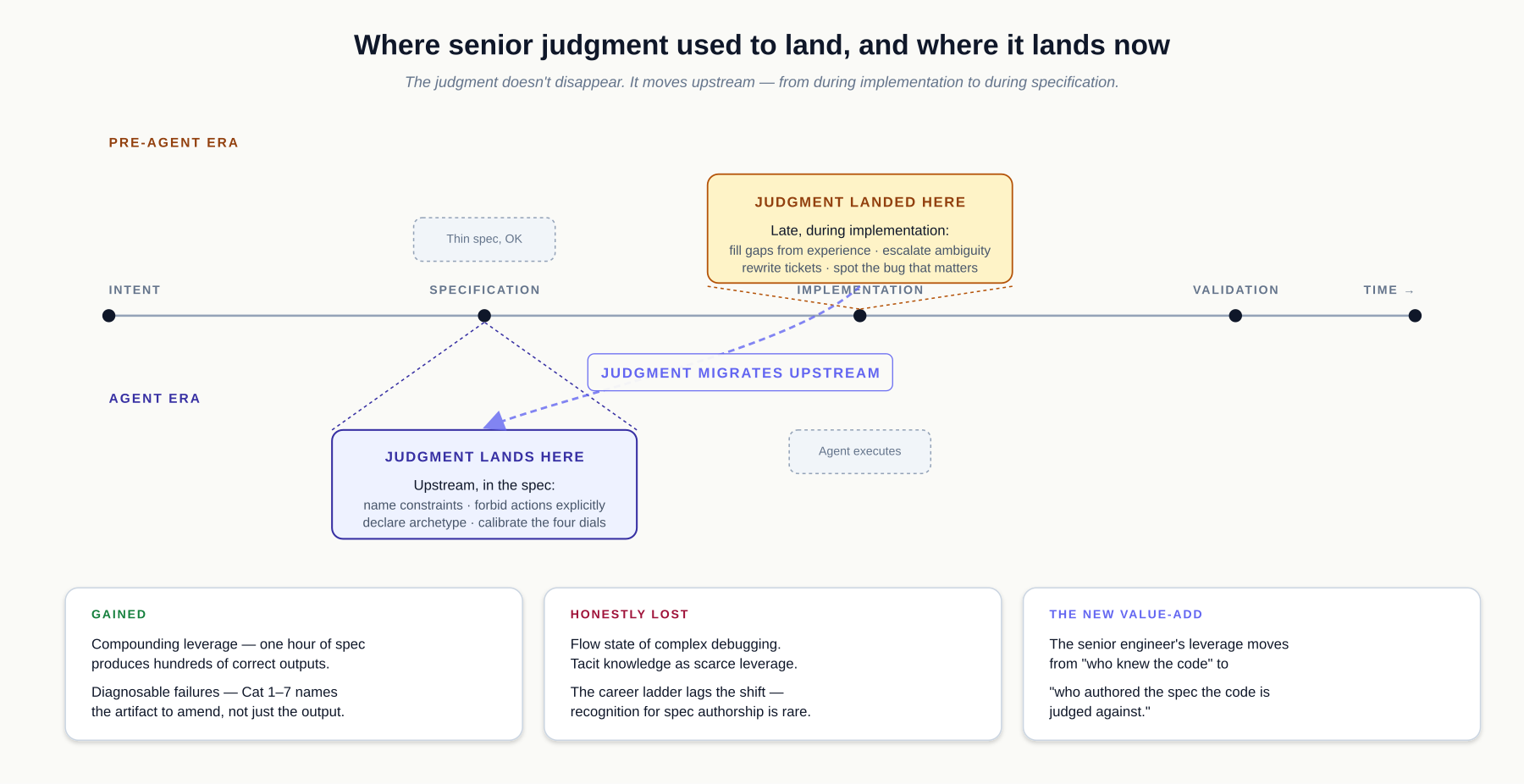
1. Late-judgment work shrinks. The work senior engineers used to do — read a vague spec, supply missing constraints from experience, escalate when something looked off, rewrite the ticket into what was actually meant — is precisely the work that has no equivalent when the implementer is an agent. The agent does not pause; it commits. The senior engineer's compensatory move was temporal (happening during implementation); the framework's response is structural (happening before implementation). That structural move is the rest of this book.
2. Tribal knowledge decays as leverage. The senior engineer who knew the codebase deeply, who remembered why a particular invariant existed, who could spot the bug that mattered without grep — they had leverage because that knowledge was scarce and locally embedded. Agents have read the codebase too, faster, and without the lossy compression of human memory. The leverage that used to come from "knowing the code" decays; the leverage that comes from having authored the spec the code is judged against rises.
Both changes are real, neither is total, and both have personal costs the framework should not minimize. The rest of this chapter is about where the judgment goes, what is honestly lost in the move, what is gained, and where the career ladder fails to keep up.
Forces
- Sunk cost vs. honest reframe. A senior engineer's career is years of investment in late-judgment skill. Telling someone "your late judgment is now upstream" can sound like devaluing the investment. It isn't — but it requires honest reframe, not minimization.
- Personal preference vs. industry direction. Some senior engineers genuinely enjoyed late-judgment work — the flow state of complex debugging, the satisfaction of a clean fix to an architectural drift. That preference is real; the industry's shift away from rewarding it is also real. Both are true.
- The career ladder vs. the work. Most engineering ladders measure lines-shipped, code-review-counts, mentoring of juniors. The shift in where senior judgment lands implies the ladder needs to update — but ladders update slower than the work.
- Personal continuity vs. personal change. A senior engineer can be valuable without doing the same things they used to do; the value just lands in a different part of the lifecycle. But "becoming valuable for different things" is a substantial personal transition with real costs.
The Solution (or, more honestly: how to think about it)
Where the judgment goes
The compensatory judgment doesn't disappear. It moves upstream, and it changes shape. Specifically:
Into Frame. The judgment that used to ask "what was clearly meant by this ticket?" now asks "what is this system trying to achieve, within what constraints, and how will we know it is working?" Same question, asked earlier, with a different set of stakeholders in the room. The senior engineer is the domain owner, the architect, or the spec author — whichever role best matches their actual leverage.
Into Specify. The judgment that used to fix a bad PR description after the fact now writes the spec clauses that prevent the bad PR description from causing damage in the first place. The §6 Invariants section, the §3 Out of Scope clauses, the §8 Authorization Boundary — all of these are senior judgment encoded once so it doesn't have to be exercised every time.
Into Bind Patterns. The judgment that used to know "this codebase needs Y safety pattern because we burned ourselves last quarter" now goes into the IDS's Bind Patterns phase. The patterns aren't "general best practice"; they're bound to specific spec clauses by someone who has seen the failure mode the pattern prevents.
Into Skeptic. The judgment that used to ask "what could go wrong?" during code review now asks the same question during the IDS, when the answer can become a constraint instead of a comment. The skeptic's role in the framework is, in effect, a senior engineer's late-judgment instinct given a structural seat.
Into Validate. The judgment that used to debug a confusing failure now diagnoses by fix locus — naming whether the failure was Cat 1 (Spec) or Cat 4 (Oversight) or Cat 7 (Perceptual), and amending the artifact whose modification prevents recurrence. The senior engineer's reading of "this is the kind of failure where..." becomes the categorization that drives the spec evolution log and, downstream, the Discipline-Health Audit.
The pattern across all five: late-judgment skill is not lost; it is shifted in time and externalized into artifacts. The skill itself — knowing what's wrong, knowing what to ask, knowing what could go wrong — is the same skill. Where it lands is different.
What is lost honestly
The framework should not pretend the transition is painless or universal. Some real losses, named without minimization:
The flow state of late-judgment debugging. Some seniors found a particular satisfaction in inheriting a confusing system, debugging it deeply, and producing a clean fix. The framework's structural response — make the failure diagnosable upstream so it doesn't have to be debugged downstream — eliminates much of that flow. For some practitioners, this is a real loss. The work they liked is rarer.
Tribal knowledge as a competitive moat. The senior engineer who was the keeper of "why we don't use library X" or "the right way to add a new feature in this module" had value precisely because that knowledge was hard to replicate. Encoding that knowledge into specs, ADRs, and constraint libraries is the framework's directive — and it dilutes the moat. The directive is correct; the dilution is real. A senior engineer whose value lived mostly in their head is being asked to externalize it into artifacts. That feels different even when the externalization is the right move.
Pure-implementation seniority. A senior engineer whose seniority lives mostly in how fast they can write correct code faces a competitive surface that has shifted. Code generation is no longer the bottleneck. Seniority that does not move upstream into Frame, Specify, or Validate is competing on an axis that is becoming less differentiated.
Some senior engineers will not make the transition. This is the hardest thing to say honestly. The transition is real and not always comfortable. Not everyone wants to do upstream work. Some practitioners chose the field because they liked the late-judgment fix, and being told the work has moved feels like being told the work they signed up for is gone. That is correct. "I don't want to" is a legitimate response. Organizations that pretend otherwise will lose some of their best practitioners to other work or other industries — which is itself a form of organizational drift the framework cannot fix from the inside.
What is gained
Authorship that compounds. A spec the senior engineer authored governs every run the agent does against it. The leverage is no longer per-incident; it is per-deployment, then per-team, then per-organization. A single hour of careful spec authorship can constrain thousands of agent decisions correctly, indefinitely.
Durable artifacts. The judgment that used to be ephemeral — in the engineer's head, in their PR comments, in their hallway conversations, in their on-call notes — becomes a durable artifact: the spec, the manifest, the constraint library, the ADR, the spec evolution log. It survives the engineer leaving the team. It scales beyond a single conversation.
Leverage across teams. The patterns, the archetypes, the spec templates a senior engineer establishes get reused. The work doesn't have to be redone for each new system. The framework's Repertoire is the explicit artifact for this kind of compounding.
A different kind of seniority. The senior engineer's role becomes more architectural and less tactical. They are still doing engineering — but the engineering is now more about designing the surfaces other people (and other agents) operate against, less about being the one who writes the next line of code. For some practitioners this is the work they always wanted to do but didn't have the structural permission to. For others, it is a substantial change in what the day feels like.
The career-ladder problem
Most engineering ladders measure things that no longer correlate well with senior value. "Lines shipped" measures implementation throughput; if implementation is automated, the metric measures the wrong thing. "Code-review counts" measures involvement; if the spec is doing more of the review work, the metric measures the wrong thing. "Number of bugs fixed" measures late-judgment debugging; if structural fixes are landing earlier, the metric measures the wrong thing. "Mentoring juniors" measures one form of knowledge transfer; if the framework's discipline is to encode knowledge into specs and constraint libraries, that measure misses the codified part.
A ladder that measures the right thing in 2026 measures structural artifacts: specs amended, invariants articulated, oversight gates designed, post-mortems with fix-locus categorization, evolution-log entries authored, repertoire entries contributed, Discipline-Health Audits led. These are harder to count than lines or PRs, which is why most ladders haven't updated. Organizations that don't update theirs will systematically reward the wrong work, and their senior engineers will gradually drift toward the rewarded work, regardless of whether it is the valuable work.
The framework cannot fix the ladder. It can name the gap. The senior engineer who reads this chapter and recognizes the gap is in a position to be a credible voice for changing how their organization measures senior contribution. The book takes the position that this is part of the senior engineer's responsibility under the new discipline: not just to do the upstream work, but to make the case that the upstream work is what should be measured. Otherwise the ladder will pull good practitioners back to the work that gets noticed, and the discipline will not survive its first few quarters.
What does not change
The values that made senior engineering valuable still apply: judgment under uncertainty; taste about what good looks like; willingness to say "this isn't right" before there is evidence; stewardship of artifacts other people will inherit; refusal to ship things you don't trust. These don't go away. They just attach to different artifacts.
If anything, those values matter more now, because the structural artifacts the framework produces (specs, manifests, constraint libraries, oversight models) are load-bearing in a way that ad-hoc late-judgment never was. The senior engineer who exercises judgment about a spec is exercising judgment about every future run of the system the spec governs. The amplification goes both ways: a careful spec compounds; a careless one compounds too.
A note on rate
The transition is not happening to every senior engineer at the same rate, and it is not happening to every domain at the same rate. Codebases with a long history of brittle implicit invariants will move slower than greenfield agent systems. Regulated domains will move slower than consumer-internet domains. Teams whose seniors already lived upstream (architects, platform leads, framework maintainers) are already in the new regime; teams whose seniors lived in late-implementation flow have further to travel.
The book makes no prediction about how long the transition takes in any specific organization. It only stakes out the position that the direction is settled: late-judgment compensation is shrinking as a senior-engineer value-add, and the work the framework names is what fills the gap.
Resulting Context
After this chapter has done its work:
- The senior engineer has a vocabulary for the transition. The Prologue named the problem; this chapter names the response. They can describe what they used to do, what is changing, where their judgment now lands, and what is honestly lost in the move.
- The losses are visible and named. The chapter does not pretend the transition is painless or universal. Some practitioners will not make the move; that is named explicitly rather than glossed over.
- The career-ladder gap is named. Organizations that haven't updated their ladders will systematically reward the wrong work. The senior engineer is in a position to advocate for measurement that matches the work — and the framework takes the position that doing so is part of the new senior responsibility.
- What does not change is also visible. The values that made senior engineering valuable in the first place — judgment, taste, stewardship, refusal to ship things you don't trust — don't go away. They attach to different artifacts and matter more, not less.
Therefore
The senior engineer's compensatory late judgment — the invisible value-add that made vague specs work — does not survive automation. The judgment moves upstream: into Frame, Specify, Bind Patterns, Skeptic, Validate. The framework's discipline is what makes that move structural rather than aspirational. What is lost is real (the flow of late-judgment debugging, tribal knowledge as a moat, pure-implementation seniority); what is gained is also real (authorship that compounds, durable artifacts, leverage across teams, a different kind of seniority). Some senior engineers will make this transition; some will not. Organizations that do not update their ladders to measure structural artifacts rather than implementation throughput will lose the ones who do. The framework cannot fix the ladder; the senior engineer who recognizes the gap is the credible voice for fixing it.
Connections
This pattern assumes:
- Prologue: What Changed and What's at Stake — the framing this chapter responds to
- What is the Architecture of Intent? — the discipline this chapter situates the senior engineer within
- The Intent Design Session — the operational ritual where the senior engineer's judgment lands
This pattern enables:
- Roles & Responsibilities (RACI) Card — the role-to-activity matrix that locates the senior engineer's judgment by activity
- Adoption Playbook — the path by which an organization moves to the practice this chapter describes
- Signs Your Architecture of Intent Is Degrading — the audit that catches when the discipline has decayed back to late-judgment compensation in a different form